The market cut the bench and bid for the switch, in the same week.
This was earnings week for the labor-based model, and the tape returned its verdict. Four Indian majors reported four different moves and none re-rated; IBM lost a quarter of its value in a day on a mainframe miss while its AI order book sat untouched. In the same window an acquirer put roughly ten billion dollars on a model-routing switch. The market priced down what you rent and bid up what you would own.
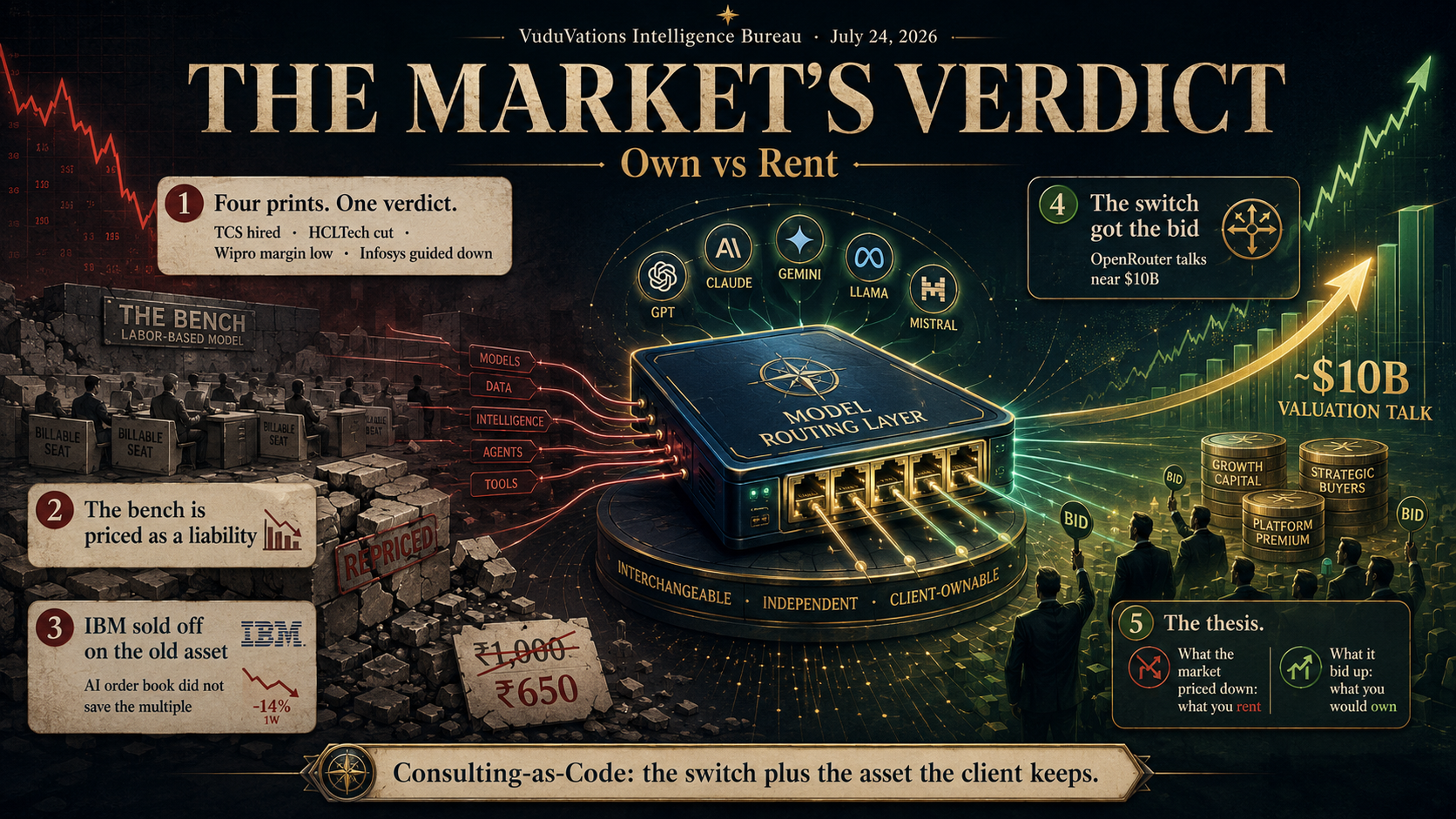
The verdict came in as earnings. For two weeks the labor-based consulting model reported its results, and the market read back the argument this desk has made all year: the bench is priced as a liability, and no AI story reverses it. Four Indian majors reported four different moves, and the outcome was the same for all of them, none re-rated. IBM, the one incumbent that owns its own AI models, lost a quarter of its value in a single day on a mainframe miss while its large AI order book sat untouched. And in the same window, an acquirer put roughly ten billion dollars on the one asset the argument says survives all of it, the switch.
The four Indian majors reported inside ten days, and each answered the bench question differently. TCS hired into the discount, its biggest addition in about four years. HCLTech cut headcount the sharpest in five quarters, tied part of it to AI, posted record bookings and held its guidance, and was sold off about three percent anyway. Wipro posted a fifteen-quarter-low operating margin with AI investment named as the cause, even as its chief executive framed AI as expanding the market rather than shrinking it. Infosys held its bench, kept its margin guidance, and disclosed a record share of revenue from AI, then trimmed the top of its growth outlook, named a successor to its chief executive, and was marked down regardless. Four moves, hire, cut, hold and compress, hold and guide down, and one verdict: the market priced the bench, not the results. The industry’s most-read analyst named the mechanism on the day of the Infosys succession, every gain in productivity a provider creates puts pressure on its own labor-based revenue. Investors agreed.
IBM ran the same play one industry over. Its early second-quarter warning crashed the stock twenty-five percent in its worst day on record, and the final report confirmed why: mainframe revenue fell forty-two percent and the full-year growth outlook was cut. Against it, IBM pointed to a strong hardware cycle and a large and growing AI order book. It did not matter. AI is not killing the mainframe, the company insisted, which is the same defense the services firms make about their bench, translated into hardware: the incumbent insisting the old asset is fine while the market discounts it. A record AI book could not offset the repricing of the thing underneath it. The lesson is not that IBM is weak; it owns more of its stack than any services firm. The lesson is that owning the model does not save you when the value the market prices still lives in the old asset.
While the labor model was marked down, the switch was being bought. Stripe entered talks to acquire OpenRouter, a marketplace that lets a buyer reach, compare and change between AI models through one connection, for roughly ten billion dollars, up from a little over one billion in May. The caution comes first: it is talks, not a closed deal, and it could still fall apart. But the number is the signal. A payments company paying seven or eight times a two-month-old price for the routing layer is the market putting a value on the freedom to change models, with a checkbook rather than an opinion. It is the clearest outside confirmation yet that the durable value is the switch, the layer that decides which model runs, and not any model beneath it. The same week, Microsoft kept performing the swap the prior edition documented, moving more of Office off its supplier’s models and onto its own.
Line up the week and it becomes one sentence. The bench got a cut: the Indian majors and IBM were both marked down on their labor and their old assets, whatever the AI line attached. The switch got a bid: an acquirer put about ten billion dollars on the routing layer, and a hyperscaler kept changing the models under its own work. What the market priced down is what you rent. What it bid up is what you would own. But notice the height of it. OpenRouter is the switch as a shared marketplace, it moves traffic between models. The position the market still has not been shown is the switch plus the workflow the client owns outright, written as code that runs on whatever model it points to and keeps a record anyone can check. That is Consulting-as-Code: the routing, the policy and the audit as code the client keeps, with the model a part you swap and the bench a cost you no longer carry. Earnings week proved each half on its own. What no one shipped is both together, to the client, as something they keep.
The market spent the week doing two things at once: cutting the bench you rent and bidding for the switch you would own. The argument did not need defending. It needed only the tape.