The Standards War: how the US and China are building two AI operating systems
The model race is over. The fight moved to standards, protocols, and market-access rules, and it is splitting enterprise AI into two partially incompatible stacks. Trusted AI is now a compliance category.
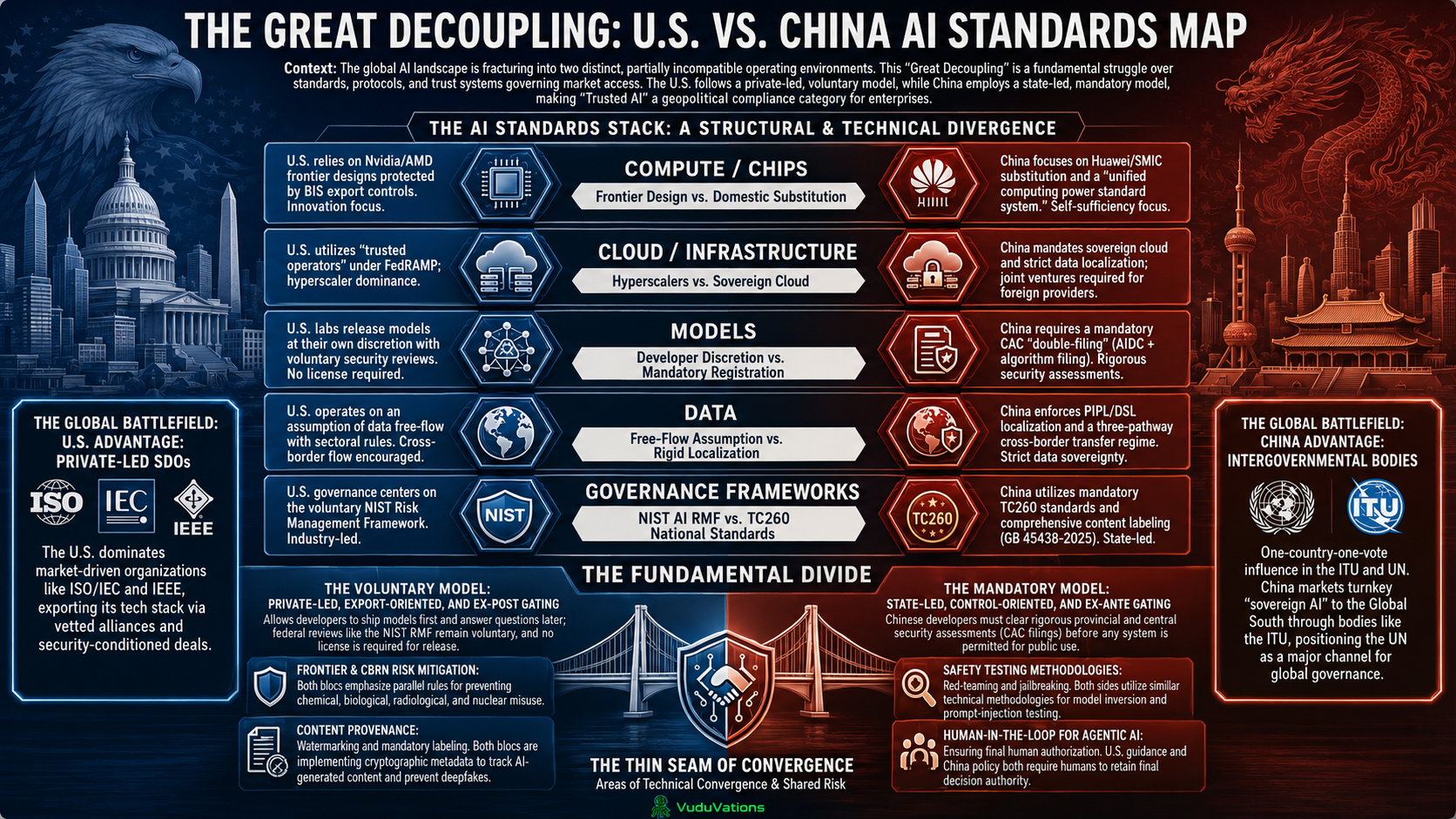
On January 27, 2025, Nvidia lost five hundred and eighty-nine billion dollars of market value in a single day, the largest one-day loss in US stock market history. The trigger was not an earnings miss. It was a Chinese open-weight model called DeepSeek R1. Everyone read the moment as a story about model performance, who was ahead and whose benchmarks were better, and everyone got it wrong. The real US-China AI contest is no longer about who builds the smartest model. That phase is over. The fight has moved somewhere less visible and more permanent: standards, protocols, trust systems, and market-access rules. Who decides which chips you can buy, which cloud you can run on, which models are legal to deploy, and what trusted AI even means.
The United States and China are no longer just building competing models. They are building two different operating systems for the global AI economy, and any business that touches AI now has to live inside the split. Picture AI as a stack: chips at the bottom, then cloud, then models, then data rules, then applications, and on top of all of it governance, procurement, and geopolitical access. For three years the headlines covered the bottom of that stack, the export controls on Nvidia chips. The competition has since climbed every layer. Both countries are writing the rules at each one, and their answers differ so sharply that the outcome is a structurally bifurcated world: a US-aligned stack and a China-aligned stack, partially incompatible by design.
The American model is private-led, voluntary, and export-oriented. Its foundational document is the NIST AI Risk Management Framework, released in January 2023, organized around four functions: govern, map, measure, and manage. It is rigorous and entirely voluntary. No licensing, no pre-approval, no penalty for ignoring it. It works the way US tech standards always have: industry adopts it because customers, insurers, and government buyers begin to expect it.
Then the philosophy sharpened. In January 2025, Executive Order 14179 revoked the Biden-era AI order and its mandatory compute-reporting thresholds. July 2025 brought America's AI Action Plan, more than ninety federal actions across three pillars, accelerate innovation, build infrastructure, and lead in international AI diplomacy and security, with exporting the American stack as the centerpiece of the third. The AI Safety Institute was renamed the Center for AI Standards and Innovation, or CAISI, its mission reoriented from safety research toward national security. What the federal government reserves for itself is the national-security perimeter: export controls on advanced chips, and a June 2026 executive order that defines covered frontier models through a classified benchmarking process, with a thirty-day voluntary pre-release review the major labs are now finalizing. The same order explicitly bars mandatory licensing. In America you can still ship a frontier model without asking permission.
Underneath the policy runs a commercial engine. The GSA OneGov deals put ChatGPT Enterprise and Claude into federal agencies at a dollar per agency, and FedRAMP authorizations more than doubled in fiscal 2025, from forty-nine to one hundred fourteen. That is how trusted AI gets operationalized in the American system: certification, a government reference customer, and hyperscaler distribution. Not law, market gravity. The complication is that the federal picture is voluntary while the states are not. California's SB 53 frontier-disclosure law took effect on January 1, 2026. Colorado passed the first comprehensive state AI act but then delayed it to January 1, 2027 and narrowed it. Even inside the US, compliance is fragmenting.
Now flip to China, where the model is state-led, mandatory, and control-oriented, and has been building since 2017, when the State Council published the New Generation AI Development Plan: keep pace by 2020, lead in key fields by 2025, become the world's primary AI innovation center by 2030. The center of the system is the Cyberspace Administration of China, the CAC, and a mechanism with no Western equivalent. Before any public-facing generative service launches, the developer files with both provincial and central regulators, documenting training data and algorithms and demonstrating that outputs align with core socialist values. As of April 30, 2026, eight hundred and sixty-eight generative services had completed filings. Because registration requires using pre-filed models, it is effectively illegal for a public-facing service in China to call an unfiled foreign API. You cannot point a Shanghai app at a Western model endpoint. That is an administrative offense, not a gray area.
Then there is content. Since September 1, 2025, China enforces the world's first comprehensive mandatory AI-content labeling standard, GB 45438. Every AI-generated text, image, video, and audio file needs a visible label, at least five percent of the shortest side of the frame, plus tamper-resistant metadata: provider ID, model ID, and timestamp. Platforms retain generation logs for six months, and the regulator runs annual Qinglang audit campaigns to enforce it; the first AI-focused edition removed more than fourteen thousand non-compliant products. The data layer sits on the Cybersecurity Law, amended in October 2025 to cover AI, alongside the Data Security Law and PIPL: important data stays in China, and outbound transfers need a security assessment, a standard contract, or certification. China keeps extending the regime to the frontier. April 2026 brought rules for anthropomorphic AI, minor modes, dependency warnings, and a forced break reminder after two hours of continuous use. May 2026 brought guidelines on autonomous agents, requiring scenario-based filings in sensitive sectors such as healthcare, transport, media, and public safety, and mandating that humans keep final decision authority. Where the US optimizes for speed, China optimizes for traceability and social stability. Neither system pretends to be the other.
Here is where it turns geopolitical. Both countries reached the same conclusion: whichever standards a country adopts is the ecosystem it locks into. Standards are the new trade routes. The American play is the alliance-stack deal. During the May 2025 Gulf trip, the US unveiled a five-gigawatt AI campus in Abu Dhabi and Saudi Arabia's HUMAIN venture, with Nvidia GB300 systems, AMD, AWS, and hundreds of thousands of GPUs. The fine print required that American companies operate the data centers and that G42 divest from Chinese partners like Huawei. Compute for allies, on the condition that the whole stack is American-run and Chinese vendors are excluded.
The Chinese play is capacity-building diplomacy: open-weight models, DeepSeek, Qwen, and Zhipu, that anyone can download and run cheaply, carried on Digital Silk Road infrastructure, and a proposed World AI Cooperation Organization that Premier Li Qiang announced in July 2025, positioning the UN as the main channel for AI governance. It works where price matters. Chinese open models, led by Alibaba's Qwen, are widely adopted across much of the Global South, even as DeepSeek is banned on government devices across the US-aligned bloc: Italy, Australia, Taiwan, South Korea, India's finance ministry, and more than seventeen US states. The same models are welcomed in one bloc and barred in the other. The institutional battlefield mirrors the split. The US holds structural advantage in the private-led bodies, ISO, IEC, and IEEE, and the club forums, G7, OECD, and the AI Safety Institute network that pointedly excludes China. China holds advantage in the ITU, one country one vote, backed by the G77, and in UN processes, where a China-led 2024 resolution on AI capacity-building passed by consensus. Neither side can dislodge the other, so both institutionalize their home advantage.
It is not divergence all the way down. On frontier risk the two systems are converging. CAISI's evaluations focus on demonstrable national-security dangers, cyber, biosecurity, and chemical weapons. China's TC260 Safety Governance Framework, version 2.0, added loss-of-control and catastrophic-risk grading over the same ground, and the testing methods, red-teaming, jailbreak resistance, and adversarial evaluation, look alike on both sides. Watermarking and provenance are converging technically too: China mandates visible labels and encourages embedded metadata, the US promotes the same through NIST and the voluntary C2PA coalition, and both lean on cryptographic metadata in the file. Both are writing data-center energy and cooling standards, because physics ignores ideology. And both flagged autonomous agents as the next control problem within weeks of each other in 2026. The pattern: convergence at the technical and measurement layer, hard divergence at governance, content, and access. Engineers agree; sovereigns do not.
So what does this mean for anyone deploying AI commercially? First, you can no longer run one global stack. A China-facing workflow needs CAC-registered models, mandatory labeling, localized data, and six-month generation logs. A US-facing workflow needs FedRAMP-class controls and NIST alignment and cannot easily use Chinese models. The two are not reconcilable in a single configuration. Picture a New York bank rolling an AI assistant across its global offices, including a Shanghai joint venture. In the US the developer volunteers the model for review and the bank ships on schedule. In Shanghai the same assistant hits a wall: the model was never filed with the CAC, the regulator issues an administrative warning, and the rollout stops. To resume, the bank rewrites its application layer to call an approved domestic model, and from that day it runs two separate AI pipelines, one per bloc. That is the new default architecture, not an edge case. Which is why multinationals are building what architects call jurisdiction-aware routing: the application detects where the user is and how the data is classified, then routes the request to a legally compliant, physically localized model endpoint. Data-residency logic, but for intelligence itself.
Second, model choice is now a geopolitical compliance decision. A Chinese model in US critical infrastructure can trigger a national-security review; an unfiled Western model in China violates registration law. Chip origin and cloud operator have become compliance-relevant facts, not just performance choices. Third, trusted AI is crystallizing into a commercial compliance category, like SOC 2 or data residency. Deloitte's 2026 survey found that seventy-seven percent of companies now factor country of origin into AI vendor selection, and nearly three in five build primarily with local vendors. Vendors who can certify against NIST, ISO 42001, or China's TC260 will charge a premium for it. As for who wins: US hyperscalers lock in the allied world, Chinese platform firms hold their home market and much of the Global South, and the consultancies profit from the fragmentation itself, the way they once profited from GDPR. Accenture and the Big Four sell responsible-AI and sovereign-AI practices as compliance offerings; in Accenture's European sovereignty study, forty-eight percent of organizations named compliance as their primary motivation, and IBM's generative-AI book of business passed twelve and a half billion dollars in 2025. Complexity, it turns out, is a product.
The most exposed position belongs to the firms in the middle, the Indian IT majors. TCS, Infosys, and Wipro are deeply embedded in the US stack, with more than three hundred thousand Microsoft Copilot seats deployed across the three, and they are packaging that experience into cross-border delivery and advisory. They are the bridge between the two systems, and they are also exposed, because the same agentic AI they deploy threatens the labor-arbitrage model their industry was built on. India's own policy body, NITI Aayog, warned in an October 2025 roadmap that on a business-as-usual path the sector's headcount could fall from roughly seven and a half million toward six million by 2031. The bridge is profitable until the traffic learns to cross by itself.
One honest caveat: on both sides, rhetoric runs ahead of implementation. Most of the ninety actions in the US plan are not yet executed, the World AI Cooperation Organization is still a proposal, and both governments keep reversing themselves on chips. The direction, though, is clear. For thirty years we assumed technology converges, one internet, one app ecosystem, one set of rails for global business. AI is breaking that assumption. The physical internet stays connected, but the intelligence layer is splitting in two: whose chips, whose cloud, whose models, whose definition of trust. Empires once projected power by controlling trade routes. Today's trade routes are compliance frameworks and API endpoints, and the question for every company is no longer whether to choose a stack. It is which one, and what it costs to keep a foot in both.