Microsoft swapped its AI models under Office, and the work never noticed.
Microsoft began routing tens of thousands of weekly Office prompts through its own models instead of OpenAI and Anthropic, proving the model is a part you can change. The consulting field answered by renting the client every layer above the model except the one that survives the swap, the switch it owns.
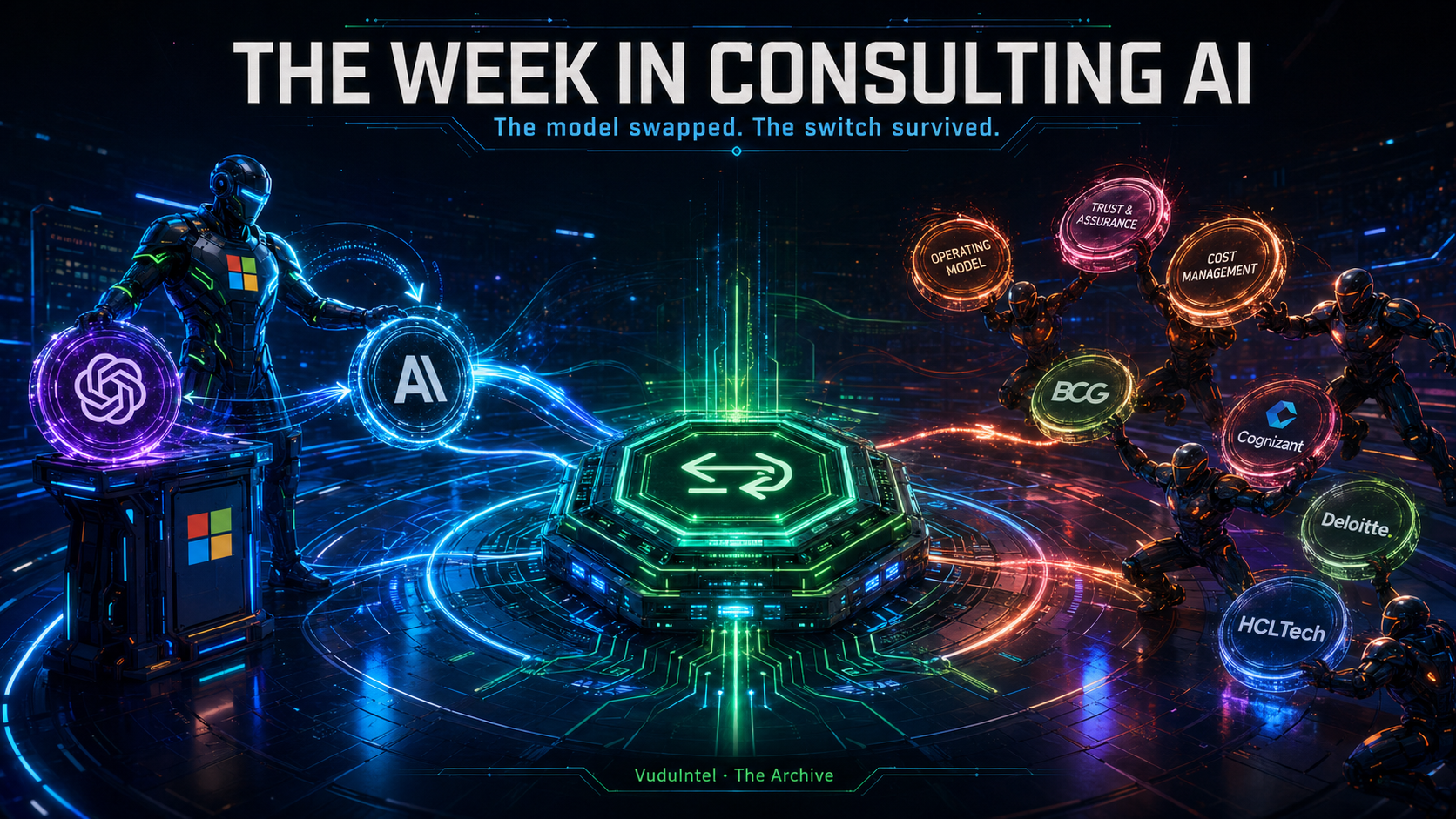
For a year the field argued over whether a company is locked to the AI model it starts on, and this week the argument was settled, not by a consultant but by Microsoft. It began routing tens of thousands of weekly Office prompts through its own models instead of OpenAI and Anthropic, and the work carried on exactly as before. That is the whole thesis rendered as a fact: at the point where a model plugs into a real workflow, the model is a part you can change, and it was just demonstrated at the largest scale in enterprise software. The prior edition ended on an open question, what does the client own when the model is swapped. This week the largest software company on earth answered it by swapping it.
Mustafa Suleyman was blunt about why. Microsoft pays a great deal to its model suppliers, and the goal is to reduce and eventually eliminate that cost by owning the layer that decides which model runs. Palantir’s Alex Karp described the same pressure from the buyer’s side: what technical customers actually want is control over their compute, their models and their data, and the rent-per-use arrangement has, in his words, gone completely wrong. Two very different companies, one conclusion: the model is a cost line, not a marriage. The part that does not travel is the prescription. Microsoft can afford to build its own model to escape its own bill; almost no company can. The part that does travel is the switch. Microsoft won its independence not by owning a better model but by owning the layer above it, the routing and policy that let it change what runs underneath without changing the work on top.
The sell side answered the swap by pricing around it. The Wall Street Journal put the industry on the record: the billable hour is going obsolete and the firms are scrambling to price like software companies. The number that ends the debate came from McKinsey, where a senior partner said more than thirty percent of the firm’s global fees now come from pricing tied directly to client outcomes, and growing. It is the first hard outcome-pricing figure from the largest strategy house. Deloitte’s own internal chart projects hourly work shrinking to a sliver of the market by 2035. Everyone agrees on the destination. The trap is the journey: a firm built on billing hours has to redefine itself to price like a product. A product born as a product does not.
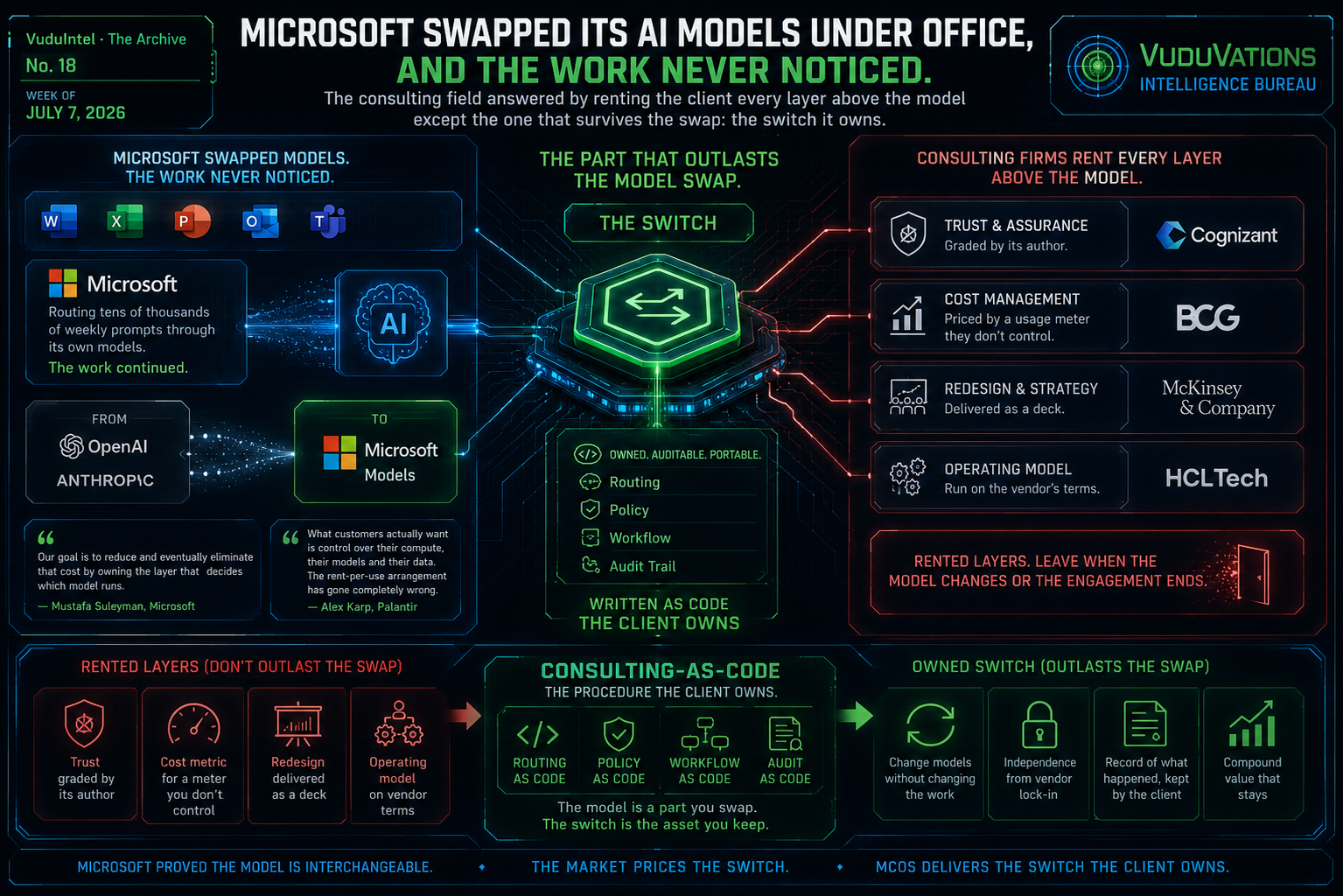
With the model turned into a commodity, the firms moved their margin up a layer, to governing it. Cognizant launched a productized trust and assurance layer the same week one of its own AI leaders named an enterprise governance crisis in multi-agent systems. But a trust product you buy from the firm that built your agents is graded by the party it is meant to check, and it leaves when the engagement ends. BCG gave the cost of intelligence a scoreboard, dividing the value of the output by the combined cost of people and model usage. The trouble is the denominator: priced by the usage meter, it moves every time the suppliers change their prices, which is a target nobody at the table controls. And HCLTech booked a billion-dollar deal to run an AI operating model for a client, proof that AI grows revenue, delivered as a system the client runs on the vendor’s terms. Trust, a cost metric, an operating model: three more layers, all rented.
Line them up and they are one shape: a layer you rent. Trust graded by its author. A redesign delivered as a deck. A cost discipline for a meter the suppliers are switching off. A vendor-run operating model. Each one leaves the moment the model changes or the engagement ends. What survives is the switch, the routing and the policy and the record of what happened, written as code the client owns. Microsoft owned its switch and changed its model without blinking. Almost no company can build its own model to get that independence, but every one can own the procedure and get the same result. That is the position none of the firms occupies: the redesigned workflow shipped as something the client owns and can run on whatever model is available underneath. Microsoft spent the week proving the model is a part you can swap. No firm has yet handed the client the switch itself, the thing that outlasts the swap.
Everything the field sold this week is rented: the trust, the cost management, the redesign, the operating model. The one asset that outlasts a model swap and the day the consultants leave is the switch the client owns.