For twenty years the bench was the asset. Now the market prices it as a liability.
In a deflation tape, headcount times rate times utilization stops being a growth story and becomes a write-down waiting to happen.
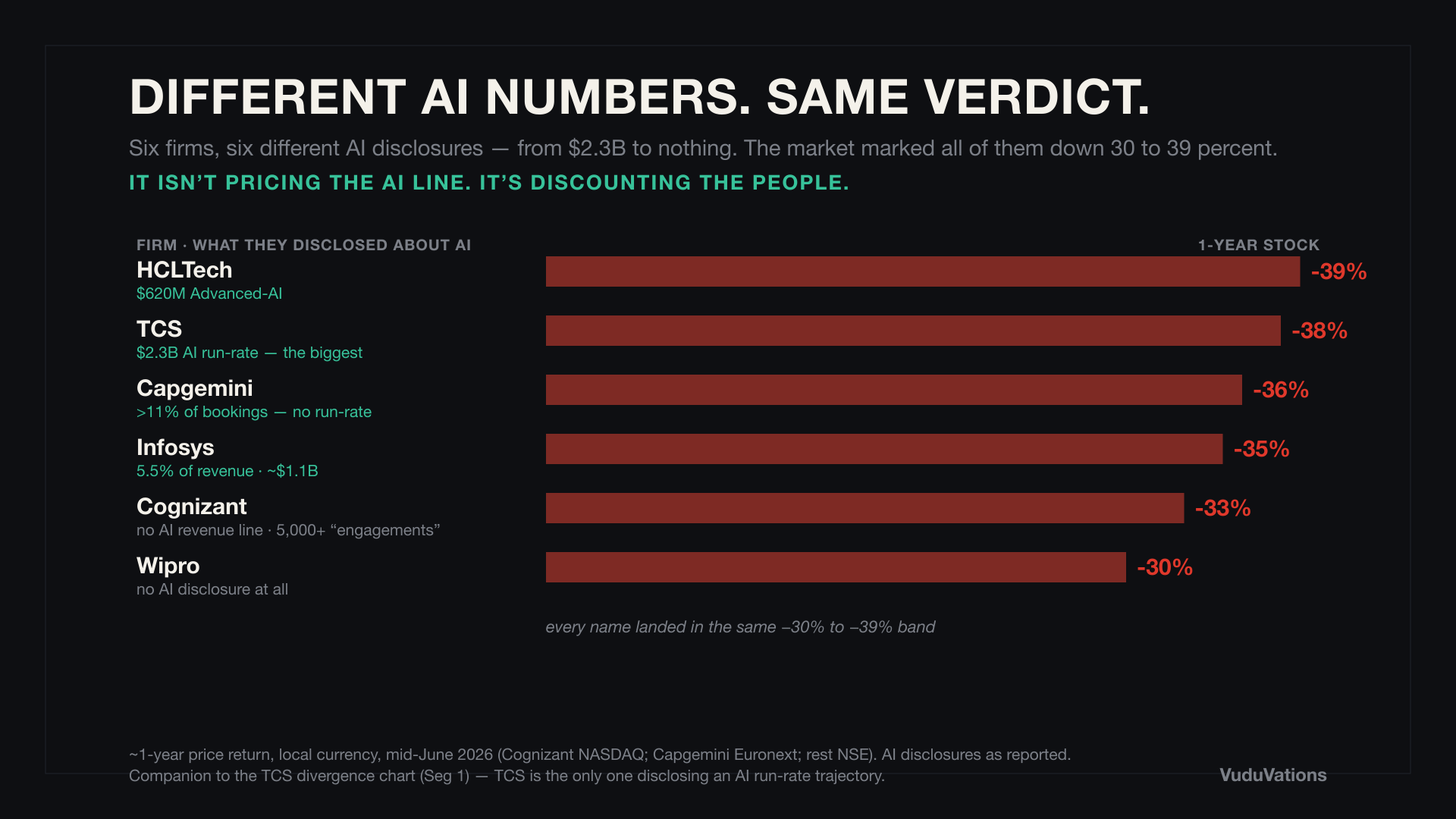
The deepest change this week was not a number. It was a reversal in what the numbers mean. For two decades a services firm's bench was its asset. Headcount times rate times utilization was the whole model, and the slide that counted the people was the growth story. The market paid a multiple for the bench because the bench compounded.
That has flipped. In a deflation the bench is no longer an asset compounding into a multiple. It is a cost the technology is expected to remove, written down in advance. The selloff has stopped pricing the AI line on top of the labor base and started pricing the labor base itself, treating every billable head as a liability in waiting.
The executives spent the week describing the opposite. The dominant theme on the roster was the race to wire Claude into delivery, alongside a newer one, AI economics entering the profit and loss statement, with talk of tokenomics, outcome pricing and cost governance. That is the polite, forward-looking vocabulary for the exact deflation already underway. The executives describe a transition they intend to manage. The market is pricing a transition it has already decided the outcome of.
Both halves of the week pointed at the same fact from opposite ends. The value is leaving the billable hour. The one thing that does not get repriced is the value a client owns and can run without the bench, an engagement whose result is encoded, auditable and portable, that keeps working when the model is swapped and the consultants go home.