The market prices the layoffs before the firms have made them.
The repricing leads and the restructuring follows: HCLTech took the full haircut while net-hiring, and Accenture fell on a quarter it grew.
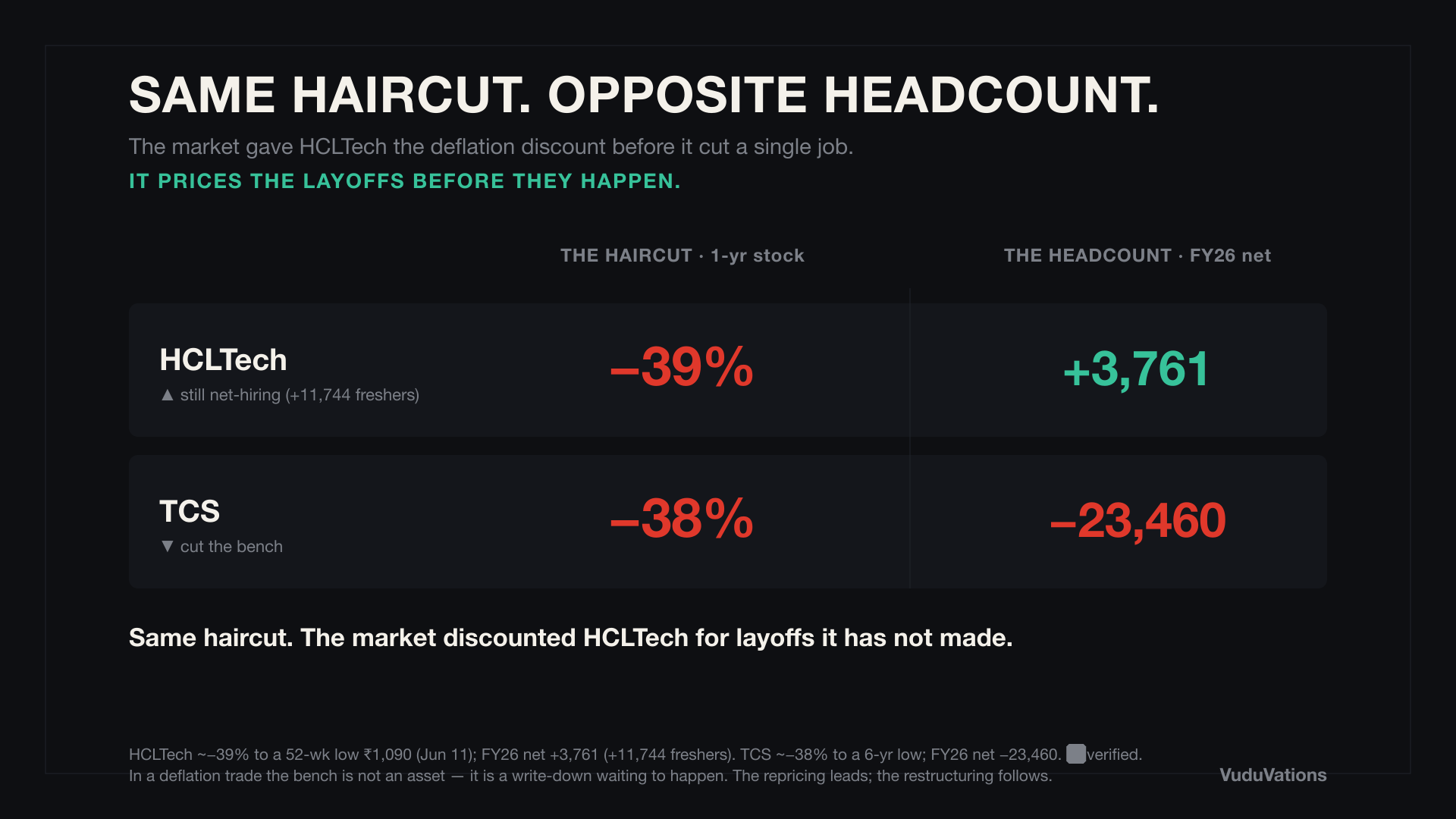
Start with the strangest fact on the tape, because almost no one named it. HCLTech finished the week at a 52-week low near ₹1,090, down about 39% from its high, the full deflation haircut the rest of the tier had already absorbed. And it had cut nobody. In the same fiscal year that TCS net-cut 23,460 jobs, HCLTech did the opposite: it net-hired 3,761 people and brought on roughly 11,744 fresh graduates. Its headline pitch is growth without adding people; the lived reality is a firm still very much adding people. Same haircut, opposite headcount. Hold those two facts next to each other, because the gap between them is the whole story.
What does it mean when the market hands you the deflation discount before you have deflated anything? It means the market stopped waiting. It is not pricing the restructuring HCLTech announced. It is pricing the restructuring it has concluded is inevitable for a business whose largest cost is billable people. The haircut is the forecast; the headcount cut is the confirmation that shows up later. HCLTech is not being marked down for what it did. It grew faster than TCS, it pays the fattest dividend in the tier, it carries the highest revenue per employee of the majors, and it still trades at a premium to TCS. It is being marked down for what its business model is. The market looked at a bench full of billable hours and priced it as a liability in waiting, whether or not anyone had been let go.
For two decades the arithmetic of this industry ran one direction: headcount times rate times utilization. The bigger the bench, the bigger the revenue, the bigger the multiple. People were the asset, and the slide that counted them was the growth story. That arithmetic just inverted. In a deflationary regime the bench is not an asset compounding into a multiple, it is a balance-sheet item waiting to be written down, and the market writes it down on its own schedule, not the firm’s. This is why disclosure did not save anyone the week before and growth is not saving anyone now. Investors have stopped pricing the AI line on top of the labor base. They are pricing the labor base itself, and treating every billable head as a cost the technology is about to remove.
If HCLTech showed the haircut can arrive without the cut, Accenture showed which one leads. On Thursday, June 18, Accenture reported a quarter where revenue actually grew, up about 6% reported and 3% in constant currency, and beat on earnings per share. The stock fell roughly 18% in a single session, its worst day since 2016. The market did not react to the revenue, which was fine. It reacted to a lowered outlook, softer bookings, and a slowdown in US federal spending. Read the sequence carefully, because it is the thesis in one trading day: the firm grew, the guidance softened, and the repricing came first and came hard. The restructuring, if it comes, will arrive later as confirmation of a price the market already set. It is the same move that hit TCS, which cut 23,460 net jobs into a six-year low. The discount becomes a mandate: once the market prices the cut, the firm is under pressure to deliver the cut and validate the number already printed against it.
The contrast with what the executives spent the week saying is sharp. The dominant theme on the roster was the Anthropic land-grab, with TCS, Wipro and HCLTech racing to wire Claude into their delivery stacks, alongside a newer and more telling one: AI economics entering the profit-and-loss statement. Accenture, Cognizant, KPMG and BCG are now talking openly about tokenomics, outcome pricing and cost governance, which is the polite, forward-looking vocabulary for the exact deflation the selloff is enforcing in the present tense. The executives describe a transition they intend to manage. The market is pricing a transition whose outcome it treats as settled. Both halves of the week pointed at the same fact from opposite ends: the value is leaving the billable hour.
The lesson is the one this desk keeps landing on, and this week made it concrete. If your value is the headcount, the market discounts you for the headcount, including the headcount you have not cut yet. There is exactly one asset the price action does not reprice for deflation: an outcome the client owns outright and can run without the bench. Not a multi-model gateway, not a bigger disclosed AI number, not a workforce vision delivered from a conference stage. An engagement whose result is encoded, auditable and portable, one that keeps working after the model is swapped and the vendor is gone. Every firm in this tier rents the intelligence it runs on and bills for the hours on top, which is precisely the structure the market is discounting in advance, before the layoffs that will eventually prove it right.
The market is not pricing the layoffs you announced. It is pricing the layoffs it knows are coming. The haircut is the forecast; the headcount cut is just the confirmation that shows up later.