The bill for three years of AI spending came due, and the receipt was missing.
The market began pricing the gap between what AI costs and what anyone can prove it returned.
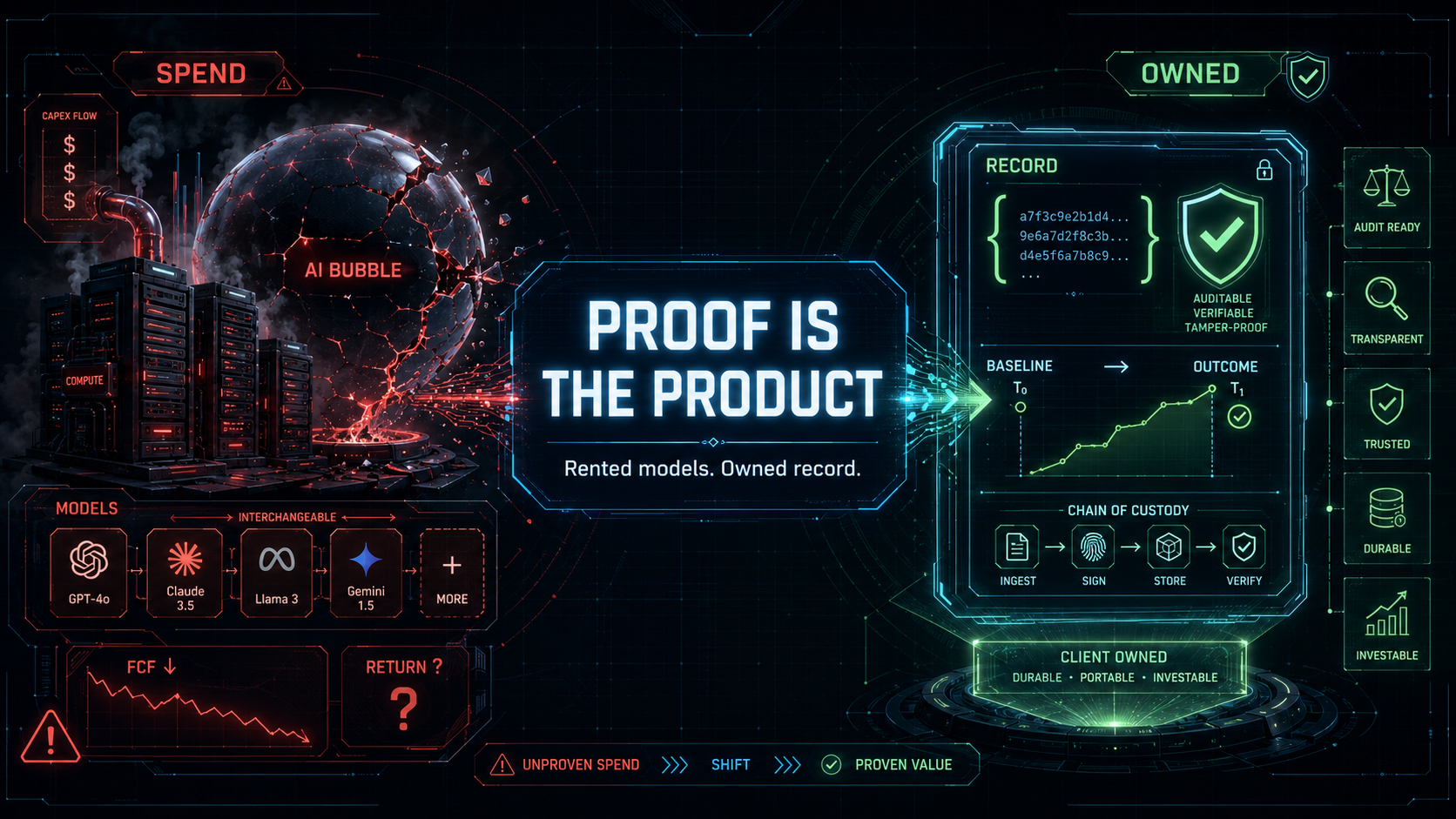
For three years the AI trade ran on a promise, and this week the promise met an income statement. Meta reported a quarter where revenue beat the estimate and the stock still fell close to ten percent, because the number that moved was not revenue. It was free cash flow, which collapsed to seven hundred and eighty-four million dollars from about eight and a half billion a year earlier, even as the company raised its capital budget again toward a hundred and thirty-five to a hundred and forty-five billion. A revenue beat, punished. That is the market saying it will no longer pay for spending on the strength of a return it cannot see.
Microsoft, reporting the night before, showed the other face of the same test: record revenue, cloud growth around forty percent, and a capital plan for next year guided toward a quarter of a trillion dollars. That is the same question Meta failed, only deferred by twelve months. The chip names slid alongside both prints, and a newer worry surfaced underneath the tape. If a company like Meta has enough spare capacity to start selling compute rather than only buying it, the scarcity that justified the valuations has an expiration date. But the prints are the symptom. The disease was named the same week, in a quieter place that carried more weight.
BCG surveyed a hundred and fifty-two chief executives at companies above five hundred million dollars in revenue, and the finding under the headline is the whole story. More than half named linking AI to the bottom line as their central barrier, and only fourteen percent said they had actually defined that impact across their AI work. The distance between those two numbers is forty-two points, and it is the distance between believing the technology works and being able to show it. HCLTech's own research put the same hole in starker terms, ninety percent reporting workflow change against eighteen percent reporting revenue impact, a seventy-two point version of the identical absence. What the firms politely call execution is, said plainly, an inability to prove.
The people actually paying for AI spent the week conceding the bill in their own words. Infosys's finance chief acknowledged AI-driven price deflation on the record, a provider admitting the technology compresses its own price faster than it can prove the value meant to offset it. Accenture disclosed that it is curbing its own routine use of generative AI to manage token cost, a firm rationing the very thing it sells to everyone else. Wipro posted a fifteen-quarter-low operating margin with AI investment named as the driver. Read together it is one admission repeated across the tier: the cost of AI is metered to the penny and the return is not measured at all.
The missing piece names itself. A dashboard number is a perception. It tells you something moved and invites you to credit the initiative next to it. A proof is a different object: an owned, inspectable record of which model ran, against what baseline, and what changed as a result, kept in a form the company holds rather than one a vendor narrates. That layer, the one that would let a chief executive answer the only question the market was really asking this week, is precisely the layer that three years and several hundred billion dollars of spending never bought. The money went into models and the compute to serve them. Almost none of it went into the record that would justify either.
Consulting-as-Code is that layer. The work is written as auditable code the client owns, with a verified baseline captured at the start and a record structured for review kept at the end, so the value is measured against something the company keeps rather than asserted on a slide it rents. The deterministic parts of the work run without touching a model at all, which takes the volatile, supplier-set token price out of the critical path, and a model is reserved for the narrow place where judgment is genuinely required, on whichever one is defensible that quarter. The market spent this week separating two things it had let blur together for three years, the money a company puts into AI and the money it can show coming back out. It marked down the first wherever it could not find the second. The product is the proof.