EY and PwC sign billion-dollar Microsoft AI alliances in the same week.
The Big Four are buying the implementation capacity the IT-services tier is restructuring away from.
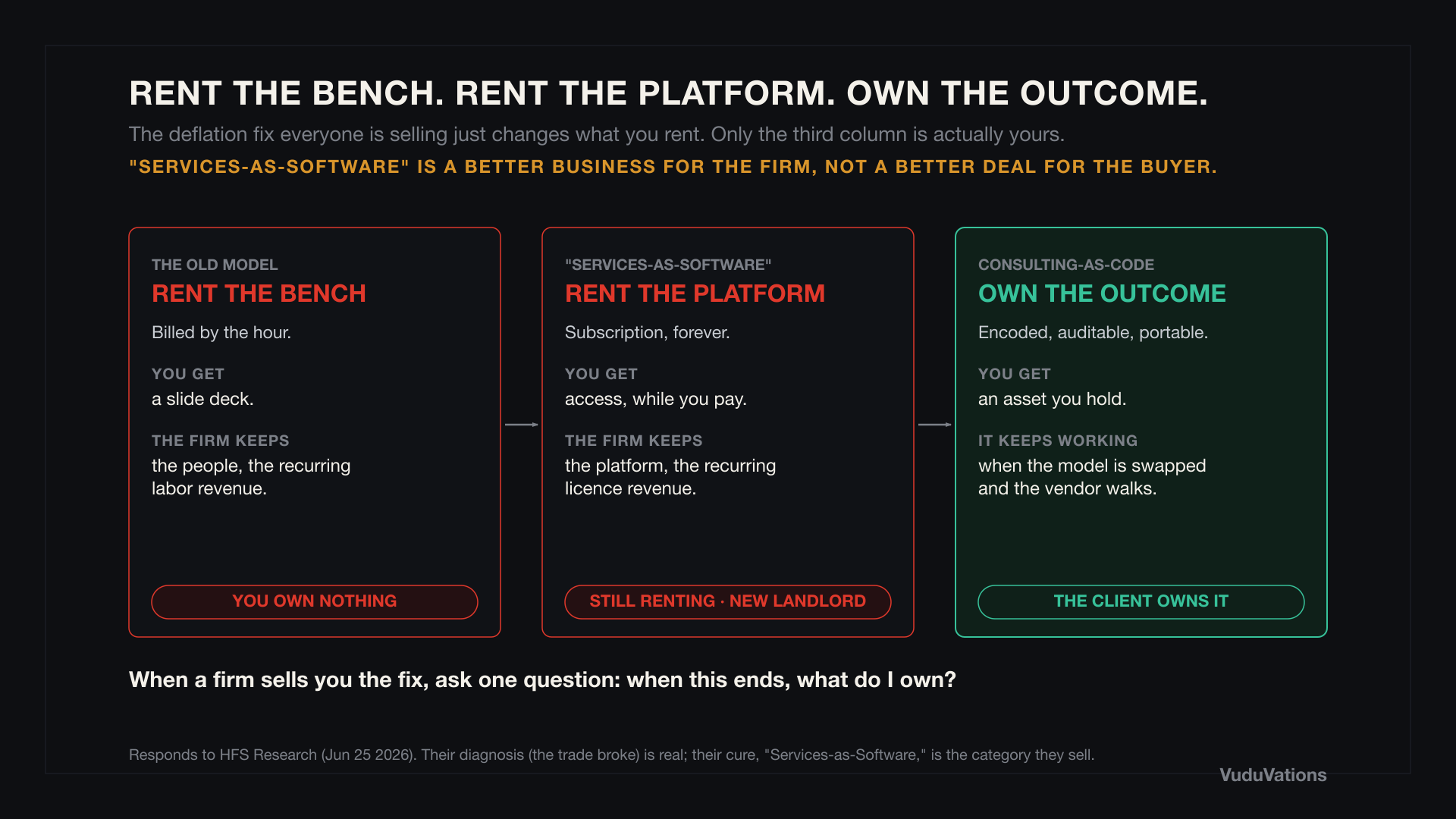
In a single week the two halves of the consulting industry moved in opposite directions toward the same destination. On May 21, EY and Microsoft announced a global AI alliance worth more than $1 billion. Three days earlier, PwC and Microsoft had launched a commercial engineering motion for AI solutions. Both announcements said the same thing in different words: the Big Four are buying implementation capacity. That same week, Cognizant executed its doubled $2 billion share buyback, the first capital return in its Project Leap restructuring. Wipro’s Pallia offered only this: the only thing that will speak for me is numbers. The IT-services tier is restructuring away from the very execution capacity the Big Four just spent a billion dollars to rent.
Consider what the alliance race is actually saying. The Big Four built their AI practices on strategic advice, telling clients which models to adopt, which governance frameworks to put in place, which vendors to evaluate. BCG’s Schweizer put the commercial pressure in the clearest terms yet: AI leaders deliver three times the cost reduction, 1.6 times the margins, and 2.7 times the return on invested capital. The firms that can point to those numbers hold the advisory premium. The firms that can actually execute toward them, at scale, with engineers inside the account, hold the commercial premium. McKinsey’s Rewired manifesto said the quiet part out loud: the advantage does not come from the tools they use, because those tools are broadly available. If the tools are common, the next premium is in knowing how to deploy them, and that is not the Big Four’s native skill. The alliances are the admission.
Hobbs made it explicit, saying execution, consistently, at pace and at scale, is becoming the differentiator. PwC is paying Microsoft to supply that execution. Truncale framed the EY alliance as moving clients beyond experimentation to scaled execution, which is the right framing, but the mechanism is a billion-dollar partnership with the platform whose engineers will do the work. On the other side, Cognizant’s $2 billion buyback is the structurally honest signal. The restructuring charges were the cost of admission: 12,000 to 15,000 positions cut, $600 million spent on the Astreya acquisition, margins guided up to between 16.0% and 16.2%. Ravi Kumar called the larger buyback a reflection of strong conviction in the long-term opportunity AI creates. That opportunity is not staff-based delivery. It is outcome-based delivery, and Cognizant is betting its capital return on the transition.
Gummadi named the driver without hedging: the firm is making these changes, he said, because the industry is shifting in ways that are real and accelerating, and they are choosing to get ahead of it. The changes are headcount cuts, restructuring charges, and a pivot toward AI-augmented delivery, and the shift he describes is the same layer the Big Four are buying into. Pallia said it in fewer words: only the numbers will speak for him. No alliance, no manifesto, just the delivery record. Both firm types are converging on one layer, the AI-orchestrated delivery that sits between the foundation model and the enterprise outcome: workflow intelligence, adoption engineering, governance, and outcome accountability. The Big Four are buying down from strategy. The IT-services tier is climbing up from execution. And that layer was built first by the platforms. IBM’s watsonx Orchestrate occupies it as a vendor-neutral control plane for agents, Microsoft sits inside both the EY and PwC delivery motions through its alliances, and the AI-native deployment shop was purpose-built for it.
Jones named what makes the crossing irreversible. Agentic AI, he said, is shifting business-process pricing away from per-staff and per-hour models toward per-outcome and per-resolution. That is not gradual erosion, it is a pricing-model break. The staff-and-hours model underwrites the IT-services delivery economics that the Big Four are now buying into by alliance. If Jones is right, and no voice in the field has offered a counter, both firm types are converging on a pricing model that is terminal in the agentic era. The Big Four are purchasing the past, the IT-services firms are restructuring away from it, and the platforms are building the future.
Neither tier has answered the question underneath the crossing. Accenture’s Sweet made the only honest internal statement on the workforce: if you want to get promoted, she said, you have to do the things the firm does to operate it. AI fluency is no longer optional, it is the condition of employment and advancement, and the firms that made that conversion internally will have the execution bench the Big Four alliances are trying to rent. The field has exactly one governance contract priced on the record, ISG’s $17 million engagement named on the Q1 call, with the firm calling governance a hot topic with the client base. That is the layer everyone is racing toward, and it is also the layer Jones says has a broken price. Neither billion-dollar alliances nor restructuring charges answer what the contract looks like when an agent delivers the outcome. The two firm types are crossing at a point that does not yet have a price, and when it gets one, the platforms will set it.
Execution, consistently, at pace and at scale, is becoming the differentiator. The firm that rents it does not own it.