Bain joins OpenAI’s $14B services venture: the biggest defection yet.
Bain takes an equity stake and the flagship-partner role, and more than half the field went quiet that week.
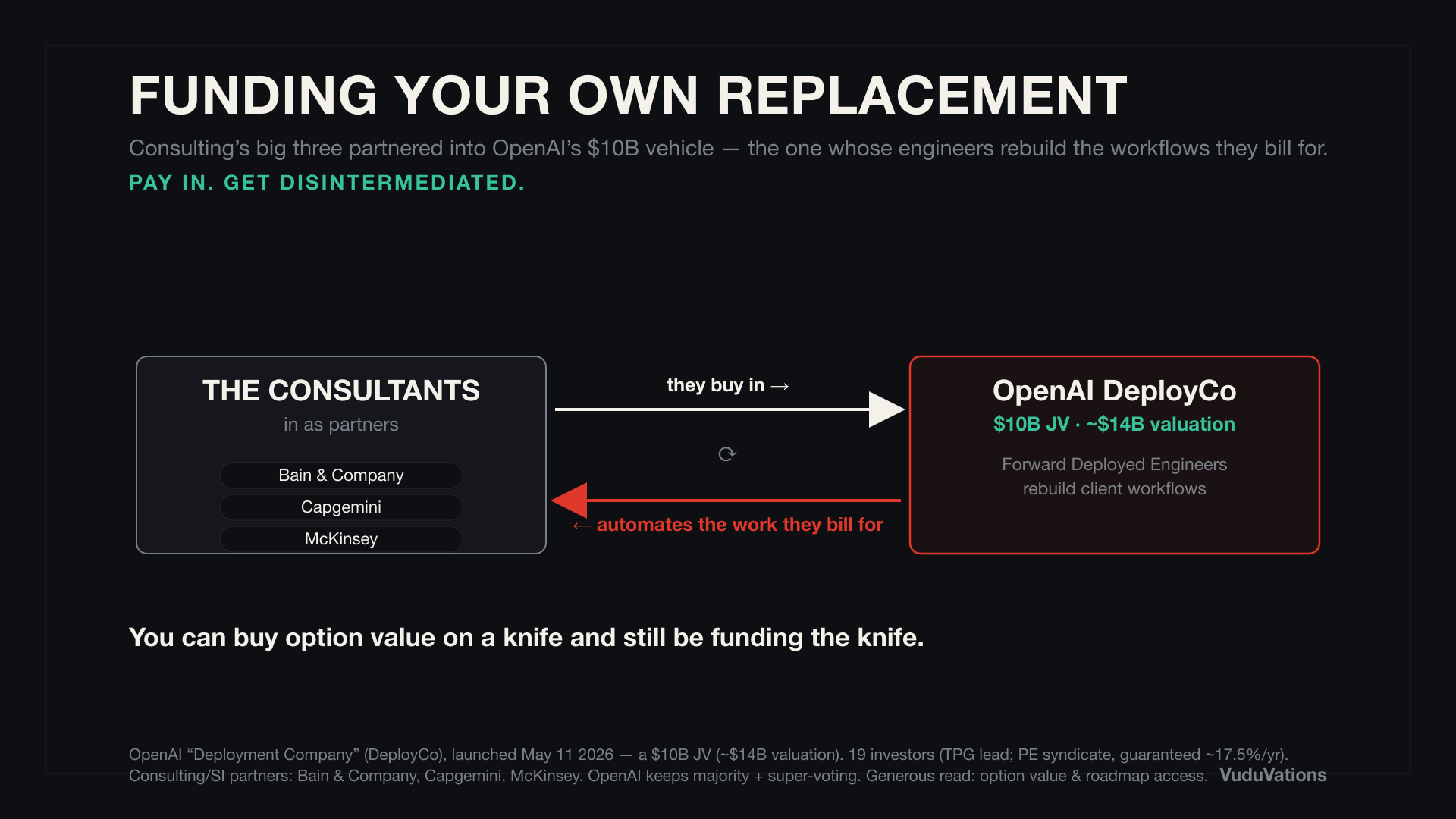
Bain & Company has been the quietest firm in this field since the first run, with no AI platform thesis, no named product, and no public account of how it would navigate the transition. That silence held until May 11, when Bain surfaced in a press release as a lead investor and named flagship consulting partner in DeployCo, the OpenAI and TPG joint venture built to create an AI-native professional services firm at a $14 billion valuation. The silence gave it away. Bain was not unprepared. Bain was deciding.
The DeployCo close on May 11, with $4 billion from 19 investors, formalized what an earlier edition called a pincer: access commoditized by Bedrock, delivery pulled in-house by the joint venture. Bain’s participation adds something neither of those observations captured. A top-tier strategy firm did not resist the entity that competes with top-tier strategy firms. It wrote a check into it. That is not a defensive move, it is Bain’s bet that the middleman model loses, and that being inside the winning vehicle is worth more than defending the old one. The flagship-partner role is not a distribution deal. It is an equity stake in a competitor paired with an operational role in that competitor’s delivery model, and the press release is explicit that Bain is not advising DeployCo, it is delivering through it.
The Arpan Sheth departure, confirmed May 7, landed in the same window. Sheth was the most prominent named Bain AI voice in the field, the architect of Bain Vector, the agent-infrastructure platform that was Bain’s closest thing to an internal AI product. His exit to become NAVEX CEO four days before the DeployCo announcement is not coincidence in sequence. Bain is closing its internal AI build and opening a position in the external build that replaces it. Meanwhile the May 13 consulting run produced the highest silence ratio in the field: 39 of 68 tracked executives published nothing attributable in the lookback window, and the Big Four and top-tier strategy firms, the ones with the most to lose if the middleman thesis fails, account for most of the silent 39. McKinsey’s Singla and Sukharevsky were silent. Deloitte’s Ucuzoglu was silent. EY’s Truncale was silent.
The platform layer ran the opposite pattern. Of 51 tracked platform executives, 37 were active, a 73 percent engagement rate in the same week the consulting layer ran 43 percent. Altman, Brockman, and Nadella testified under oath in Oakland. Garman announced 11,000 AWS software engineering interns. Krishna opened watsonx Orchestrate to Anthropic and OpenAI models on the same stage. Two open questions in the field also closed this week. First, is the AI return bottleneck the model or the workflow? Matt Hobbs codified the adoption-as-bottleneck framing at Google Cloud Next, saying AI tooling is advancing faster than most organizations can adopt it, and Ted Fernandez named the same bottleneck on the first-quarter call: undocumented exceptions, fragmented systems, and governance. Two practitioners, opposite ends of the field, same week, same framing. The debate is closed, and the bottleneck is the workflow, not raw model capability.
The second question: is the foundation-lab governance risk visible to enterprise procurement? It is now. The Musk versus Altman trial produced sworn testimony on OpenAI’s founding rift, the equity demands, Microsoft’s one-way-door rationale, and the for-profit conversion mechanics. That is not press coverage, it is a federal court record, and enterprise legal teams will start mapping their stack against it by the third-quarter procurement cycles. The platform layer also added a capability with no consulting equivalent yet: AWS previewed agent payments on stablecoin rails with Coinbase and Stripe. Agents can now transact on their own, purchasing, contracting, and committing funds without human sign-off at the transaction level. It is in preview, not on a roadmap, and no consulting risk practice has published a method for auditing agent-initiated payments.
The five weeks between DeployCo’s May 4 announcement and its May 11 close gave the clearest picture yet of where each firm stands. The firms with the most concrete moves are the ones paying for them: Cognizant’s $600 million Astreya acquisition and Project Leap restructuring, Hackett’s platform pivot with restructuring charges, and ISG’s $21 million of AI revenue at one-third of total with a named $17 million governance contract. These firms are not positioning, they are repricing. The firms publishing without restructuring charges are in a different spot. McKinsey Rewired’s second edition arrived the same week, Accenture’s Sweet appeared on Fortune and CNN, and KPMG’s Chase and Fisher extended the AI reckoning narrative. None of these are wrong moves, but they are positioning moves that do not require the thesis to change, and they cannot yet answer what happens to the premium when Bain is helping the other side close the deal.
The firms that are silent are not unprepared. They are deciding. The difference between Bain’s silence and McKinsey’s silence is that Bain’s ended with a press release.