OpenAI reaches Amazon’s cloud, ending Microsoft’s eighteen-month lock.
When every cloud runs every model, the only edge left is the procedure that runs on top.
When AWS chief Matt Garman took the stage at the What’s Next with AWS event on April 28 and announced OpenAI models on Bedrock, he said it plainly: this is what our customers have been asking us for for a really long time. The line was aimed at buyers. The audience that should have been paying closer attention was every consulting practice that spent the past eighteen months building Microsoft-aligned AI delivery infrastructure. For enterprise AI, the Microsoft and OpenAI exclusive worked like a carrier exclusivity deal for a phone: it forced buyers to pick a platform before they could pick a model. Azure was the door. OpenAI was behind it. Every firm that committed to an Azure-first AI practice was betting, knowingly or not, that the door stayed closed.
The door is open. OpenAI models, Codex, and Bedrock managed agents in limited preview went live on April 28. Anthropic has been on Bedrock for years, Meta Nova is on Bedrock, and Google runs its own model stack. A corporate buyer can now reach every significant frontier model from any major cloud. The exclusive is gone, and it is not coming back. The late-April to early-May earnings window then produced the most compressed run of AI revenue confirmations in a single fortnight. Microsoft AI annual recurring revenue crossed $37 billion, up 123 percent year over year. Google Cloud crossed $20 billion per quarter at 63 percent growth, with Sundar Pichai naming compute supply as the binding constraint. Anthropic disclosed a $30 billion annualized run rate, 80 times its end-of-2025 figure. AMD data center revenue rose 57 percent. Palantir printed 85 percent growth and coined AI slop as the buyer-skepticism phrase procurement teams will borrow within thirty days.
Taken together, the platform layer confirmed that AI revenue is large, supply-constrained, and spread across many vendors. No single firm controls access to the models. No single cloud controls access to the compute. The exclusivity era produced one winner. The multi-vendor era poses a different question: when the model is table stakes, what is the actual differentiator? Eighteen months of exclusivity had given the firms a legitimate reason to build. If OpenAI only ran on Azure, then Azure expertise was the entry point to every serious AI engagement, and Accenture, EY, Deloitte, and McKinsey all deepened Microsoft-aligned centers of excellence in that window. The logic was sound while the exclusive held.
It no longer holds, and the firms face a positioning problem they have not admitted in public. The Azure-first practice they built was a distribution play: the model sat behind the cloud, the cloud sat behind the firm. The multi-vendor era removes the first layer of that arrangement. Buyers can now reach OpenAI directly on Bedrock, on Azure, or through the raw interface. The consulting firm is no longer the access layer. It has to be something else. The leading indicator the platform run produced is explicit: watch the firms begin echoing multi-vendor foundation model strategy as table stakes within thirty to forty-five days. The briefing will be accurate, and it will cast the firm as the neutral integrator helping the client navigate new complexity. The play gets a new wrapper. The economics underneath are unchanged.
Garman’s event was not only about OpenAI. AWS executive Swami Sivasubramanian announced AgentCore generally available at the same event, the agent platform layer for Bedrock, with more than one million developer-kit downloads during preview. He framed it directly: companies need the right agentic platform. Salesforce AgentForce, the next-generation IBM watsonx Orchestrate, and the Supervisor interface for Google’s agent kit all reached general availability in the same two-week window. Four agent platforms going live in a fortnight is not a coincidence. The hyperscalers have declared their winners at the platform layer. The fight over what runs on top of those platforms, the business logic, the decision trail, the process specification, is the next phase, and it is just starting.
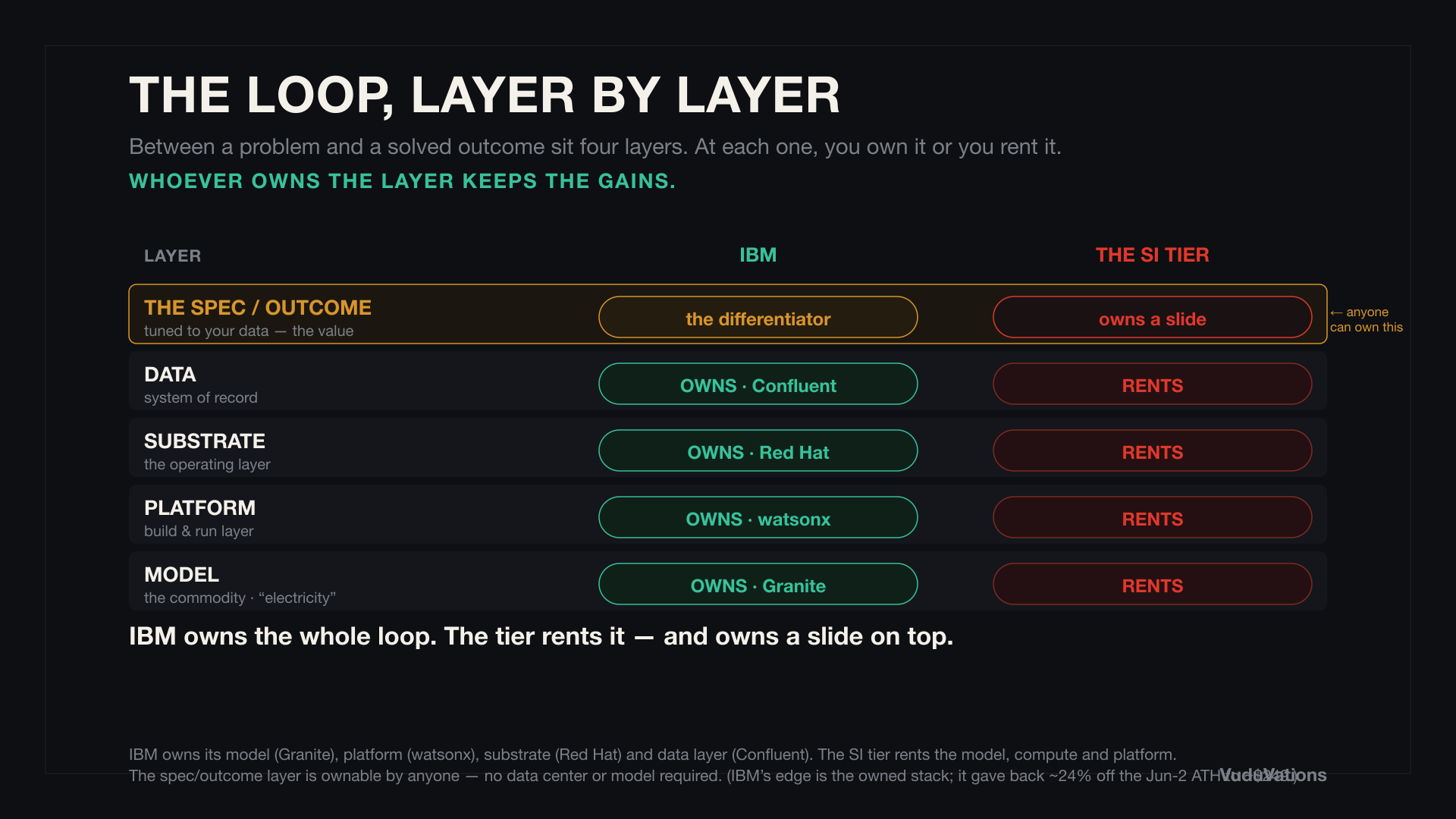
Three predictable moves are in motion. First, the firms will publish multi-vendor strategy briefings within thirty to forty-five days, and those with Google Cloud Gemini investments, namely BCG, Deloitte, and PwC, who all announced expanded Gemini partnerships at Google Cloud Next 2026 in this same window, will reframe fastest, while the Azure-only firms need a repositioning cycle. Second, the wave of agent platforms going live will spawn a new version of the old argument: when every platform runs every model and ships an orchestration layer, the complexity pitch shifts from which model to how do you govern the agents, and the governance-and-audit framing gets louder, not quieter. Third, the AI slop framing will reach procurement conversations within sixty days, and the firms that can show auditable, source-traceable output provenance will have an answer, while those selling managed services built on the same models available to everyone will not. The resolved question is which cloud controls access. The open question is who controls the specification that defines what the AI does, how it decides, and how those decisions can be audited. That is the asset, and it is the one the firms cannot sell, because owning it requires the client to not need the firm next quarter.
When the model is available everywhere, the firm that owns the specification running on it owns the outcome. The firm that owns the relationship to the cloud running it owns the invoice.