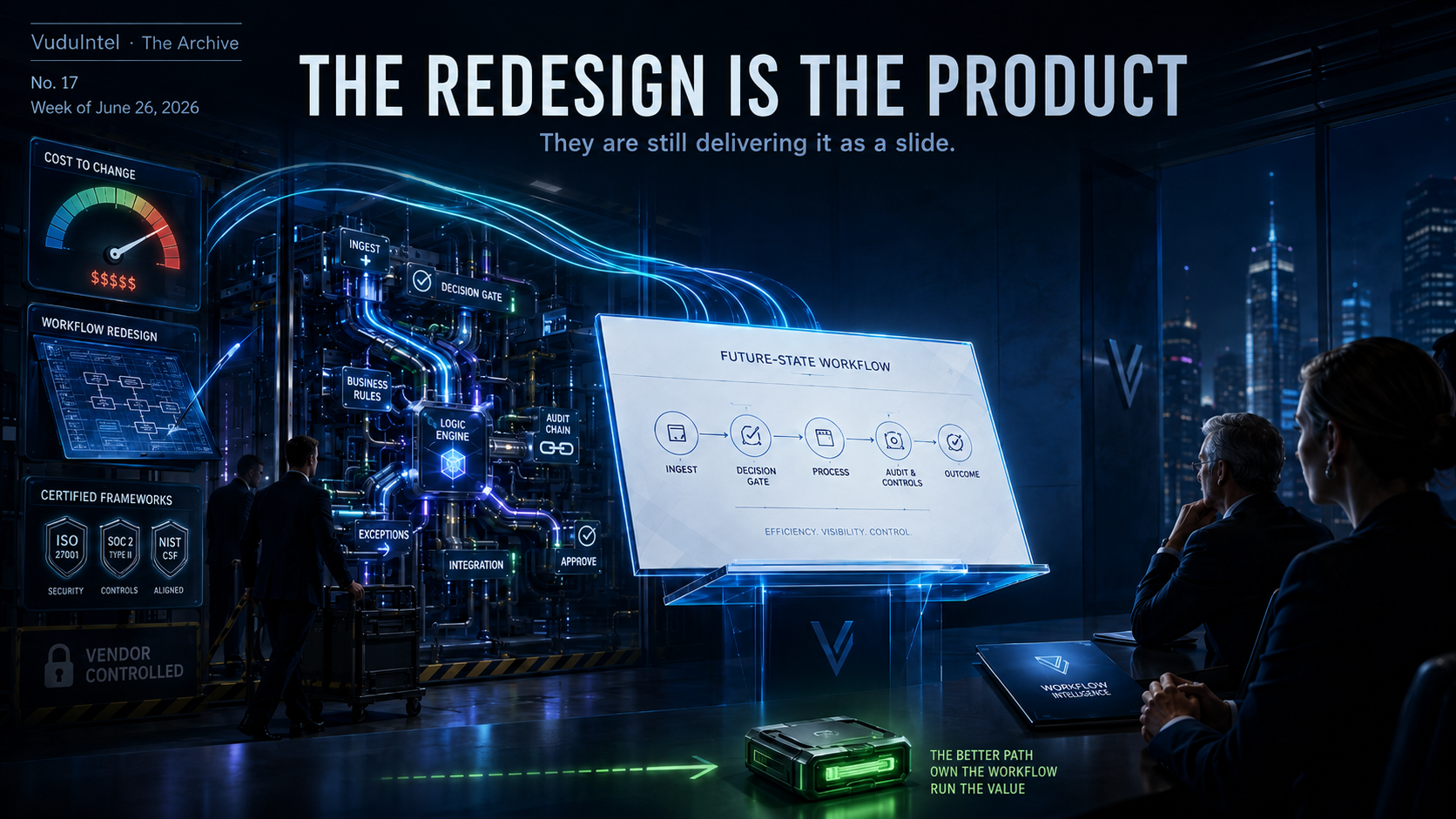
The redesign is the product, and they are selling it as a slide.
The field stopped selling what AI can do and started selling the management of it: work redesign as the billable unit, cost accounting as a service line, certified delivery as the vehicle, all priced to be governed and not owned.
For most of the year the consulting tier sold AI capability: what the models can do, how fast, at what scale. This week it changed the product. Across the Big Four and the India-heritage majors, the pitch quietly moved from the technology to the management of it. PwC, KPMG and the AI-officer voices spent the week selling work-redesign, cost-accountability and human-capital reframing as the new billable units. Accenture put a name on a token-optimization practice. Wipro stood up an Applied AI Center of Excellence for Claude and began certifying ten thousand people. Read together, it is one move performed five ways: when you can no longer charge a premium for access to intelligence that now sits on every cloud, you charge instead for governing it.
Start with the cleanest version of the trade. KPMG’s Q2 Global AI Pulse made cost visibility the dividing line for AI returns and found that only about a quarter of firms name a CEO accountable for AI outcomes. Accenture turned the same anxiety into a named practice for optimizing token spend, modeled on cloud cost management. Both are real services answering a real problem. The trouble is that the cost they propose to manage is the one their own suppliers are racing to destroy: in the same window OpenAI detailed its first custom inference chip and AWS pushed right-sizing the model as the default. Selling a discipline for managing a cost the labs are driving into the floor is an umbrella sale timed to the end of the storm. The meter is real today, and the business of metering it is built on the meter staying expensive.
The deeper move is subtler and more durable-sounding: value comes from redesigning how the work is done, not from the tool. BCG hammered it all week, end to end process redesign, agents that encode organizational identity. The diagnosis is right. The redesigned workflow is where the value lives. But notice what the client is actually handed at the end of that engagement: a recommendation, a target operating model, a deck describing the better process. The redesign is sold as advisory and delivered as advice. The moment the model changes or the consultants leave, the client owns the description of the workflow, not the workflow. A redesign you cannot run is a slide with a higher price.
The third version is the most honest about its economics and the least about its exposure. Wipro is embedding forward-deployed engineers inside client environments and certifying ten thousand people on Claude; TCS anchored Claude to regulated-industry production for fifty thousand associates; HCLTech secured Claude Code through Rubrik and took a sovereign-AI stake in Sarvam. This is real delivery capacity, and it is also the exact structure the tape has spent two months discounting: billable headcount, now wearing one lab’s badge. The land-grab concentrates delivery on a single model just as model access turned into a government-gated variable. HCLTech’s Sarvam stake is the only hedge in the cohort, and it proves the point by exception: the durable asset is the one the client owns and can run on whatever model is available, not the certified bench pointed at one.
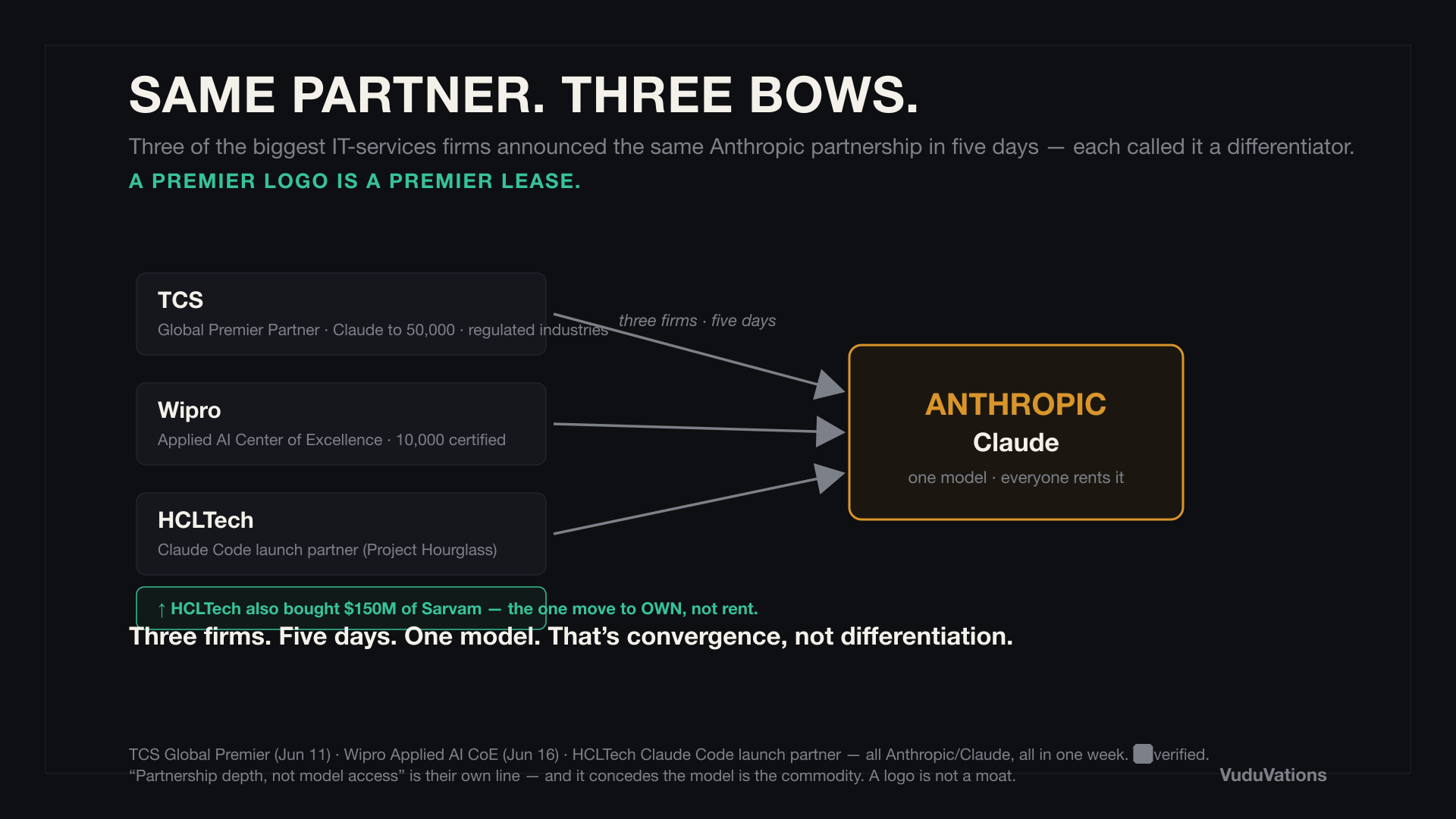
Put the three together and they answer the question the prior issue left open: what does the client own when the model is swapped? Not the cost-management practice, which evaporates when the meter does. Not the redesign, which was a recommendation. Not the certified engineers, which are the bench. The only thing that outlives the model swap and the vendor’s exit is the redesigned workflow rendered as code the client owns and can audit.
Every firm named the product this week, the redesign, without shipping it as one. Each move, token cost management, work-redesign, certified Claude delivery, reprices the engagement around governing intelligence the client rents, which is exactly the structure the market discounts. The one position none of them occupies is the redesign delivered as the asset: the workflow encoded, source-cited, model-portable and runnable without the firm that built it. Naming it was the easy half. Shipping it as a product the client runs, rather than a slide, is the opening.
They are selling you the redesign. The redesign is the product. The only question that matters is whether you walk away owning it, as something that runs, or owning a description of it.