The market marks the entire Indian IT tier to multi-year lows in one session.
Read the market and the verdict is blunt: it is not pricing the AI story, it is pricing labor deflation.
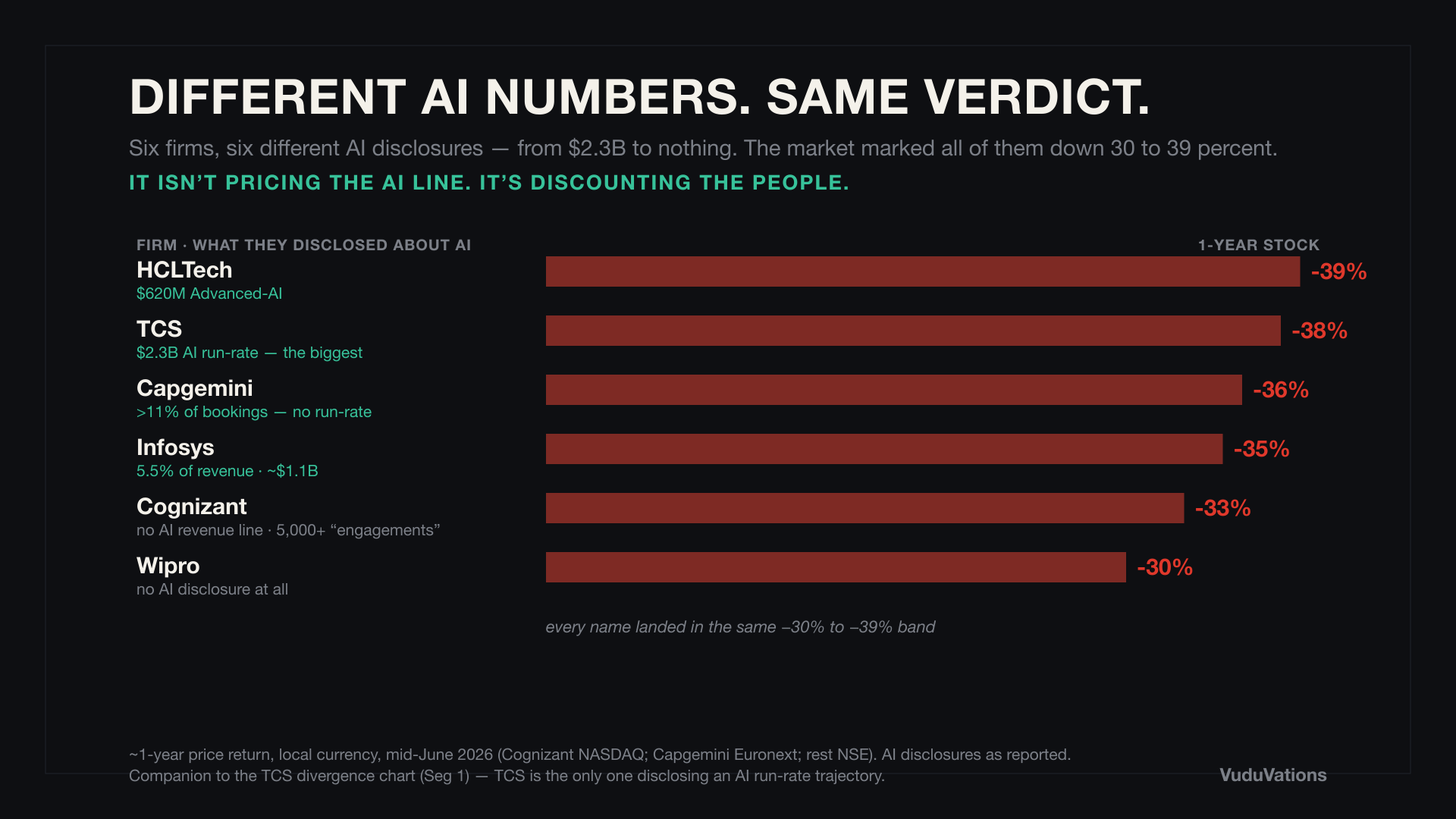
Say it plainly. By the middle of June 2026, the four largest Indian IT-services firms were all at or near multi-year lows. TCS traded around ₹2,150, a six-year low and down roughly 38% on the year. Infosys sat near ₹1,124, also a six-year low, its market value slipping below ₹5 trillion. HCLTech printed a 52-week low, off about 39% from its high. Wipro was at the floor of its range. The whole sector index was down about 24% for the year, and a single new Anthropic model release in early June was enough to knock the entire tier lower in one session. What these firms are exposed to was already settled in the price, and a stronger frontier model is the exposure.
The detail that should end the debate is what disclosure did, or rather did not, do. TCS discloses $2.3 billion of annualized AI revenue, the largest line in the sector. HCLTech discloses $620 million. Infosys said about 5.5% of a recent quarter came from AI, roughly $1.1 billion a year. Wipro discloses nothing at all. Four different answers to the same question, and one identical verdict from the market: down 35 to 39 percent. The disclosure gap produced no valuation gap. Investors are not paying for the AI line, they are discounting the base underneath it, the hundreds of thousands of billable people.
The clearest signal is a flip at the top. TCS, the fourteen-year bellwether that reports first and sets the tone, lost its premium late in 2025, and HCLTech now trades above it. Not because HCLTech’s AI story is more convincing, but because its growth is less negative and its engineering-and-software mix erodes more slowly under automation. The market has stopped ranking these firms by AI ambition and started ranking them by how exposed they are to deflation. The least-exposed name wins the relative trade. Buyers have stopped listening to strategy and started counting heads.
Look at what the boldest moves actually earned. TCS’s chairman told shareholders the firm could one day run as many AI agents as it has employees, and that agents might replace half its jobs, the most aggressive workforce vision in the sector. The stock barely moved, still at a six-year low. HCLTech’s chief executive said the firm could grow three to five percent without adding people, and in the same year it added 3,761 net staff. Every proof point, the $2.3 billion, the $620 million, the giant addressable-market number, landed where the verdict was already set. The market is not disputing the stories. It is saying: prove the loop is yours, or you are a labor business with better slides.
Satya Nadella spent the week arguing that the moat in the AI era is not the model, it is the learning loop a firm owns on top of it, the thing that compounds, encodes a company’s judgment, and survives swapping one model for another. Every firm in this tier has adopted the first half of that test. They are all model-agnostic, each running a gateway that lets a client switch the underlying model without losing the configured workflow. Not one has passed the second half. Every one of them rents the ground it runs on, from IBM, NVIDIA, Amazon, Google, Microsoft, or Anthropic through a partner. Being able to use any model is not the same as depending on none, and the market understands the difference even when the slides blur it.
The sell-off is not irrational. It is a precise question none of the four has answered. Show me AI revenue that is genuinely new, not a defensive repricing of work the client was already buying. Show me revenue that grows while headcount actually falls, not "could fall." Show me a loop the client owns outright, one that survives if both the model and the vendor walk away, with an audit trail that proves the outcome rather than asserting it. TCS cut more than 23,000 jobs net and still shrank 2.4 percent in constant currency. HCLTech promised growth without people and hired. Infosys disclosed its 5.5 percent and guided the next year to between 1.5 and 3.5 percent. The narratives describe the destination; the financials describe a tier still billing for hours and renting its intelligence one call at a time. Until one of them ships an owned, auditable, vendor-independent loop, the market will keep pricing them as exactly what it already believes they are.
A loop you run on someone else’s cloud is not a software asset. It is a services contract with an API. That is why none of these firms earns a software multiple, however large the disclosed AI line.