BCG’s biggest AI work moves off billable hours to outcome-based fees.
A strategy chief and an IT-services chief land on the same point: hours and token counts are the wrong metric.
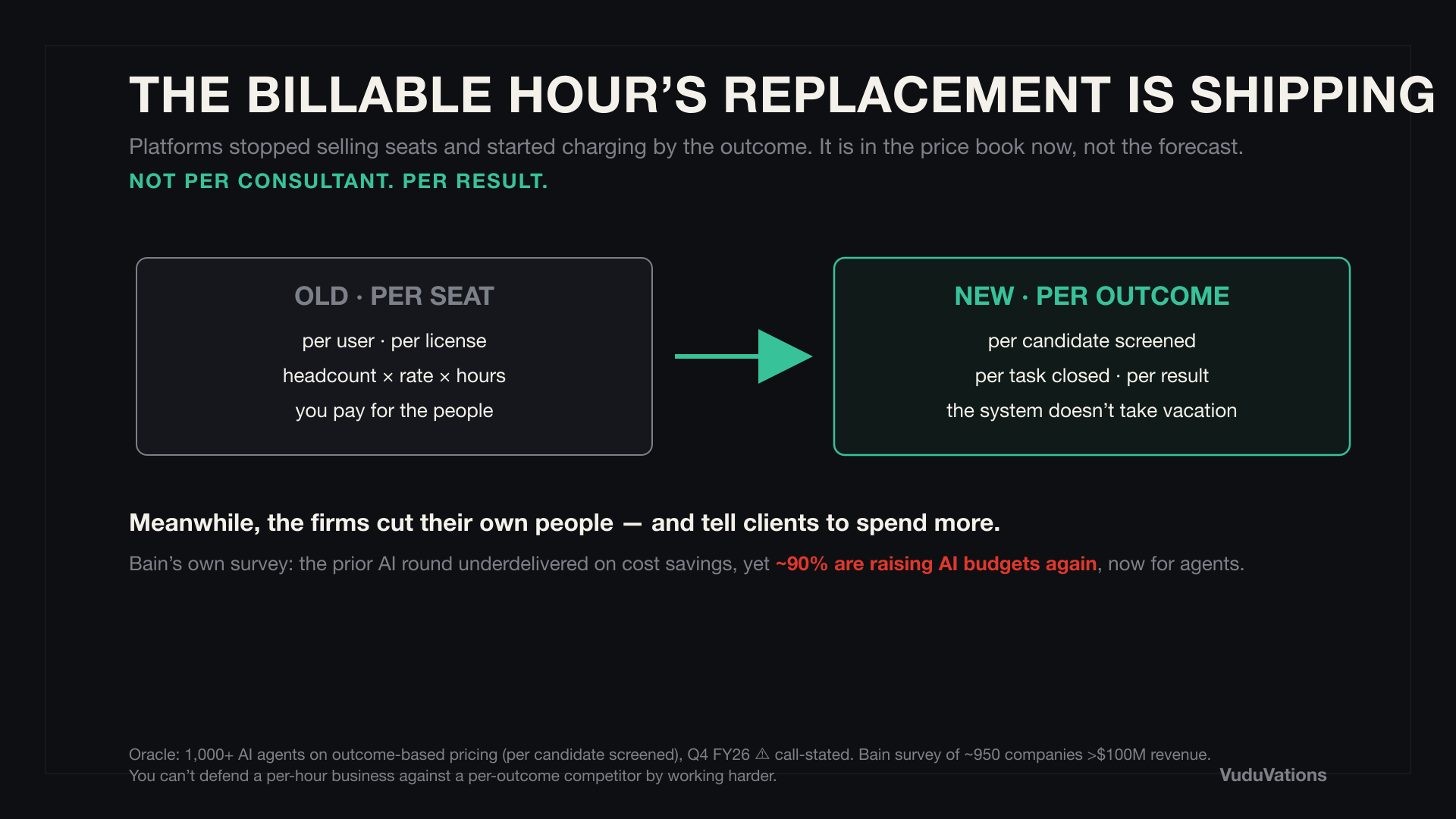
Two CEOs, in the same short window, said the same structural thing without quoting each other, and what they said reprices the model that built the consulting industry. In a Wall Street Journal profile published May 28, 2026, BCG CEO Christoph Schweizer said something no strategy-house CEO had said publicly before: most of BCG’s clients are struggling to get value out of their AI investments, and that struggle is BCG’s business. He then confirmed that the firm’s largest AI engagements are shifting to outcome-based fees, variable pricing tied to what the client actually achieves, and that less than a third of BCG’s AI work is still billed by time.
Four days later, at the Fortune COO Summit in New York, Cognizant CEO Ravi Kumar S went further. Across two placements over two days, Fortune on June 1 and June 2, he called token consumption a vanity metric, described the future of IT services as underwriting outcomes rather than delivering projects, and announced mass entry-level hiring as a deliberate counter to the AI job-destruction story. His headline line was that firms have to underwrite those outcomes and be paid for those outcomes, and that this is the future. The distinction he drew matters. Outcome-based pricing ties your fee to a result and pays you more when the client hits a target. Underwriting means you also accept the downside: if the result does not land, you absorb the loss. Kumar’s framing puts the firm’s revenue at risk on the client’s result, and saying that out loud from a CEO podium is the first time it has appeared here.
Schweizer’s version points the same direction but is structurally softer. Variable fees tied to client results is not the same as underwriting, because BCG keeps the upside without committing to a loss floor. Still, the direction is identical: away from time and materials, toward the client’s outcome. That the largest strategy house and a major IT-services firm named the same destination in the same week is not a coincidence. It is a market signal. Kumar’s attack on token consumption deserves its own treatment, because tokenmaxxing, the practice of maximizing enterprise AI usage as a proxy for AI maturity, was BCG’s own framing in earlier runs, with Sylvain Duranton urging firms to push token spend as the leading measure of AI-era value. Kumar is now calling that metric vanity from a Fortune stage, and he is not wrong: usage measures activity, not whether the activity produced a result anyone would pay for. The firms that built their AI advisory around usage dashboards are now defending a number the IT-services CEO is publicly taking apart.
While the fee model repriced, a parallel race ran through the window as every major firm with real signal rushed to name its proof of scale. KPMG and Anthropic embedded Claude across 276,000 employees through Digital Gateway, the largest single-firm foundation-model rollout in the field. Infosys’ Salil Parekh used the FY26 annual report to claim AI-led programs across 90 percent of the firm’s top 200 clients. EY anchored its alliance with Microsoft, worth more than $1 billion, around a Client Zero story: its own 150,000-user Microsoft Copilot deployment as proof it can do to clients what it did to itself. But these are not the same kind of claim. KPMG’s 276,000 is an internal productivity number, not a client outcome. Infosys’ 90 percent is client breadth, not depth or dollar impact. EY’s Client Zero is a reference deployment, not an underwritten result. None of them is underwriting. They are the scale metrics of the old model: breadth, headcount, platform penetration. The distance between those claims and Kumar’s underwriting thesis is exactly the gap the market is about to price.
Kumar’s second placement added a structural claim about middle management. Technology now bridges the gap that middle managers used to bridge between strategy and execution, which turns the role into a player-coach, someone who can both execute and develop others rather than a coordinator who owns the information asymmetry. He described needing a player-coach who is not competing with the technology but has the experience to verify and validate, which answers the displacement story, Mustafa Suleyman’s thesis that AI replaces white-collar roles within 18 months, without conceding it. In Kumar’s frame the workforce is not shrinking, it is restructuring: middle management loses its coordination premium and gains execution accountability.
The loudest part of the window may be the silence. McKinsey’s roster was almost entirely quiet, with Kate Smaje surfacing only in third-party coverage of the fee-model story alongside Schweizer, not with original McKinsey positioning. PwC, which dominated the May 29 window, produced a single Atkinson quote tied to a Forrester recognition and otherwise ran at low wattage. The pricing conversation is the most commercially significant shift in the field since ISG’s incumbency-disadvantage data, and it is happening without McKinsey’s voice and with PwC barely audible. The firms with the most at stake in the end of the billable hour are the quietest at the exact moment that transition is being named.
Outcome-based pricing pays you more when the client wins. Underwriting means you eat the loss when the client does not. One is a discount. The other is a different business, and it is the one the market is about to price.